



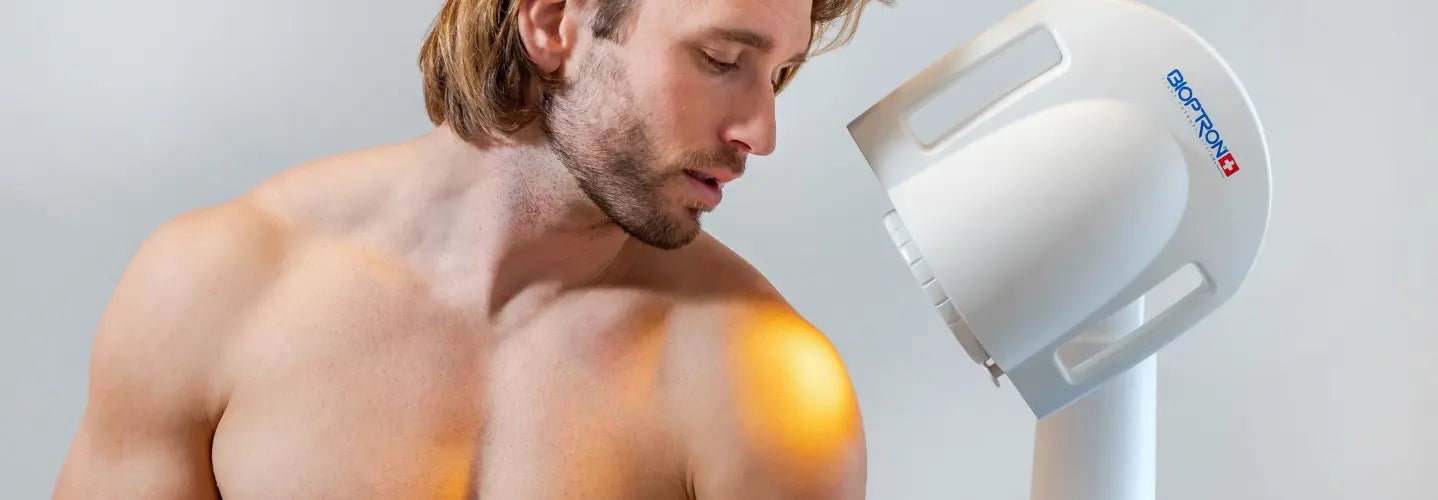
Pulled a Muscle? Where Red Light Therapy Could Fit Into Recovery at Home

You are halfway through a sprint, lifting a box, digging in the garden or changing direction when a muscle suddenly grabs. The movement stops, the area feels local and unmistakable, and once you are home the practical question is simple: does reaching for a light device make sense?
Red light therapy for muscle strain may be considered as a supportive addition once the nature and severity of the problem are reasonably clear. It does not replace assessment, rehabilitation or progressive loading.
That distinction matters because a pulled muscle is not the same thing as the familiar ache that arrives after a hard training session. Before deciding where light therapy fits, start with what happened and what the muscle can actually do now.
The moment it happened tells you more than the lamp can
A sudden, localised pull during sprinting, lifting, reaching or changing direction is a different story from ordinary post-exercise soreness. A strain is an injury to muscle tissue, while delayed training soreness tends to build after exercise rather than announcing itself in one sharp moment.
You do not need to grade or diagnose the injury yourself. What matters at home is noticing the pattern. Significant swelling or bruising, difficulty using the limb normally, worsening pain, marked weakness, or uncertainty about what you injured are good reasons to arrange an assessment with a GP, physiotherapist or other appropriate health professional.1
If the problem feels more like familiar training soreness and there was no clear injury moment, our light therapy after exercise timing guide is the better place to start. If there was a definite pull, keep the focus on an injury recovery plan rather than treating it like normal gym soreness.
Feeling less sore is not the whole recovery job
A recovering muscle has more to do than feel comfortable while you are sitting still. It needs to regain normal movement, strength and the ability to tolerate gradually increasing load.
That is why symptom relief, if it happens, is only one part of the picture. Good rehabilitation brings movement and loading back in a way that matches the muscle, the injury and the demands you eventually want to return to. Sports-medicine consensus work on hamstring injuries, for example, places progressive loading, strength and function at the centre of rehabilitation rather than relying on passive treatments alone.2
At BIOPTRON, we see home light use as an adjunct to that work. If you are already following physiotherapy exercises, do not swap them for a lamp session. If you have not been assessed and the injury is limiting normal function, getting the basics clear first can make the rest of your home plan much more useful. You can also read more about how light therapy is used in BIOPTRON sports medicine.
What the muscle-light research actually studied
Photobiomodulation, often shortened to PBM, covers research using specific light sources and treatment settings. The muscle literature is broader than true acute strain research. It includes exercise-induced muscle damage, performance and recovery studies, experimental muscle work, and some research involving injured athletes.
A 2025 systematic review and meta-analysis included healthy adults exposed to exercise-induced muscle damage. It reported low-certainty evidence for selected soreness and performance outcomes with PBM used before exercise.3 That tells us something useful about photobiomodulation muscle recovery, but it is not the same as showing that a home device heals a diagnosed acute strain faster.
A 2024 systematic review of injured athletes found a favourable pooled effect for musculoskeletal pain, but only two included trials looked at time to return to play and those did not support a faster return.4 That is an important reality check: feeling better and being ready for normal sport are not interchangeable.
There is another reason to be careful with headlines about red light therapy for a pulled muscle. PBM studies use different lasers, LEDs, wavelengths, power levels, treatment doses, timing and application methods. Those settings cannot simply be copied onto BIOPTRON, which uses its own Hyperlight system and instructions. Evidence from another PBM device can help us understand the wider field, but it does not prove the same outcome from BIOPTRON.
The setup should not become another muscle test
From our BIOPTRON team, one of the most practical points is easy to miss: using the device should not make the injured muscle work harder just to hold the light in place.
If you have pulled a hamstring, calf, shoulder or back muscle, avoid twisting, bracing or holding an awkward position simply to aim the device. Set yourself up so the area can stay as relaxed as practical. A chair, bed, supportive cushion or stand may make more sense than trying to hold a position that turns the session into another strength test.
BIOPTRON MedAll is a Swiss-made Class IIa device with an approximately 5 cm treatment filter. BIOPTRON Hyperlight is polarised and polychromatic with no UV, and MedAll has a built-in digital timer. Current NZ instructions describe positioning the light approximately 10 cm from the area and at approximately 90 degrees, with a typical current instruction of 4 to 10 minutes per area.
Those are our current device-use instructions, not a newly invented muscle-strain protocol. If a clinician has given you specific guidance for an assessed injury, keep that guidance central.
For a larger treatment area or when hands-free positioning would make the session easier, BIOPTRON Pro1 with floor stand is also Swiss-made and Class IIa, uses an approximately 11 cm treatment filter, and allows hands-free positioning. We do not claim that Pro1 produces better strain-healing results than MedAll. The practical difference here is how much area you can cover and how easily you can hold a stable position.
Judge the next step by what the muscle can do, not one quiet evening
A sore muscle can feel calmer at rest before it is ready for sprinting, heavy lifting or a full training session. That is why a comfortable evening after any recovery tool, including light therapy, should not be treated as clearance to load the muscle normally.
Look at function over time. Is normal movement returning? Can you do the rehab exercise or daily task you were given without a clear setback? Is strength being rebuilt progressively? If sport is the goal, are you meeting the movement, loading and sport-specific steps set by your physiotherapist, coach or medical team?
Return-to-sport guidance emphasises graded, criterion-based progression rather than a single symptom or a fixed number of days.2 In plain terms, the muscle needs to prove what it can do as load comes back. A quieter pain signal is useful information, but it is not the whole test.
If you are choosing a home light, think about the muscle you actually need to reach
The best home setup is one you can use without turning treatment into a wrestling match with the device. Before choosing, picture the actual area you need to reach and the position you would use.
- Access: Can you reach the calf, hamstring, shoulder or back area without twisting or tensing?
- Stability: Can the device stay at the intended angle and distance without constant adjustment?
- Treatment-area size: Would a smaller targeted filter suit the area, or would a larger filter make coverage simpler?
- Portability: Do you want a compact device you can move easily around the house or take with you?
- Hands-free use: Would a floor stand help you keep the muscle relaxed and the device steady?
- Repeatability: Can you recreate the same comfortable setup without improvising each time?
MedAll is a compact choice for targeted home sessions, while Pro1 with floor stand gives you a larger treatment filter and hands-free positioning. Neither needs to be framed as clinically better for a muscle strain. The more useful question is which setup lets you follow the device instructions comfortably and consistently around the area you need to reach.
You can explore our BIOPTRON home light options to see the available setups and choose around access, filter size, portability and positioning.
Common questions
Does red light therapy help a pulled muscle?
Research on PBM suggests possible benefits for some muscle-recovery and sports-injury outcomes, including soreness or pain in certain studies, but evidence specifically for diagnosed acute muscle strains is less direct. Red light therapy for a pulled muscle is best viewed as a supportive option beside appropriate injury care and rehabilitation, not a guaranteed way to speed healing.
Can you use red light therapy on a muscle strain?
Light therapy for muscle strain may be considered once the injury is reasonably understood and you can use the device without stressing the area. If there is significant swelling, bruising, loss of function, worsening symptoms or uncertainty about the injury, get it assessed rather than relying on home light therapy alone.
How is a pulled muscle different from normal post-workout soreness?
A pulled muscle usually has a clearer injury story, such as a sudden localised grab or pain during a movement. Ordinary post-workout soreness tends to build after exercise and is not usually tied to one distinct injury moment. If the pattern is unusual, severe or limiting normal function, an assessment is sensible.
How soon after a muscle strain should you consider light therapy?
There is no single evidence-based start time that applies to every strain and every light device. First make sure the nature and severity of the problem are reasonably clear. Then, if light therapy is suitable, follow the instructions for your device and any advice from the health professional managing the injury. Do not copy timing or dose from a laser or LED study onto BIOPTRON.
Can light therapy replace physiotherapy or progressive loading?
No. Recovery from a muscle strain still depends on restoring movement, strength and load tolerance. Light therapy can sit beside physiotherapy or an appropriate home rehabilitation plan, but it should not replace progressive active recovery or professional advice when that is needed.
Do red-light study settings apply directly to BIOPTRON?
No. Research devices differ in light source, wavelength, power, dose, timing and treatment method. Laser or LED study settings should not be transferred directly to BIOPTRON. Use BIOPTRON according to its current instructions rather than trying to recreate another device's research protocol.
How should BIOPTRON be positioned around a sore muscle?
With MedAll, current NZ instructions describe approximately 10 cm distance, approximately 90 degrees to the area, and a typical treatment time of 4 to 10 minutes per area. Position yourself so the sore muscle does not have to tense, twist or hold an awkward posture simply to keep the device in place.
When should a muscle strain be checked by a GP or physiotherapist?
Arrange an assessment if there is significant or worsening swelling or bruising, marked weakness, difficulty using the area normally, worsening pain, or uncertainty about what you injured. Seek urgent medical help for severe symptoms such as deformity, numbness or a cold or discoloured limb after an injury.
Next steps
If you want a non-invasive, repeatable home light option that can sit beside an appropriate recovery plan, BIOPTRON is worth exploring. Choose the setup around the muscle you need to reach, how comfortably you can position yourself, and whether targeted portability or hands-free coverage matters more in your home.
Keep the bigger recovery goal in view: restore movement, rebuild strength and increase load gradually. BIOPTRON can be one practical part of that plan without pretending the lamp is the whole plan.
References
- NHS. Sprains and strains. Read the NHS guidance.
- Pollock N, et al. London International Consensus and Delphi study on hamstring injuries part 3: rehabilitation, running and return to sport. British Journal of Sports Medicine.
- Canez MS, et al. Effects of photobiomodulation, intermittent pneumatic compression and neuromuscular electrical stimulation on muscle recovery: systematic review with meta-analysis. PubMed.
- Morgan RM, et al. Effects of Photobiomodulation on Pain and Return to Play of Injured Athletes: a systematic review and meta-analysis. PubMed.


