



Choosing a Light Therapy Device for Wound Care at Home: What Actually Matters Before You Buy

You can be ready to spend serious money on a home light device and still miss the question that matters most: what will one actual session look like around the wound?
Picture the person at home. Maybe they are lying on the bed with a heel supported, sitting in a recliner with a lower leg exposed, or using a dining chair because that is the only position they can hold comfortably. The device may look impressive online, but it still has to reach the right area cleanly, stay steady without touching the wound, and be practical enough to use again without turning every session into a small project.
For wound care, the best home light device is not automatically the biggest or most powerful-looking option. It is a device that is appropriate for the assessed wound, can be positioned as directed without touching the wound, fits the real body position and treatment area, and is practical enough for the person or carer to repeat consistently. BIOPTRON offers compact and stand-supported options, but model choice should be based on practical fit rather than a promise of better healing.
Start after the wound plan is clear
This article starts one step after assessment. If the wound is open, chronic, diabetic, pressure-related, infected, surgical or slow to heal, it needs appropriate clinical assessment and an established wound-care plan.
BIOPTRON can be considered as an adjunct within that plan. It does not replace prescribed dressings, pressure relief, compression, offloading, infection management, vascular care, diabetes care, debridement, antibiotics or clinician-led wound management where those are needed.
If you are still working out whether light therapy belongs in the plan at all, start with our BIOPTRON wound care information. If the plan is already clear, the next question is much more practical: can the device fit the way care actually happens at home?
Where will the person actually be?
Wound location changes the whole setup. A heel while lying down creates a different positioning problem from a lower leg while seated. A hip, abdomen, back or upper arm may be easy for a carer to reach but awkward for the person to reach alone.
Before choosing a light therapy device for wound healing, picture the position the person can comfortably hold for the full session. Can they stay relaxed without twisting? Is there room beside the bed or chair for a stand? Can the device head face the treatment area directly? Does the power cord reach safely without creating a trip hazard?
Comfort matters because a technically suitable device is not very useful if the person has to brace a leg, hold an awkward pose or keep shifting furniture every time it is used.
Can the light stay off the wound and still stay steady?
For home wound light therapy, the physical job is to create clean, non-contact access while keeping the light stable at the instructed distance and angle. With current BIOPTRON MedAll guidance, that means about 10 cm from the area and approximately 90 degrees to it. The same general positioning guidance is used with Pro1, with the included measuring tool helping with distance.
The device should not be resting on the wound or dressing. Hands, stands and nearby surfaces should be handled cleanly, and the wound-care team's instructions still come first.
Do not remove a dressing simply to make light therapy easier. If the area can only be exposed during a dressing change, follow the wound-care team's advice about when and how the dressing is removed or changed. There is no reason to change prescribed dressing timing just to fit BIOPTRON into the day.
How much moving will one session really involve?
Treatment-field size matters, but only as a practical question. A larger field can mean fewer repositioning steps across a larger area. A smaller targeted device can be completely appropriate when the treatment area is small, easy to reach and simple to keep in position.
What matters is the work involved in one full session. If the light has to be moved several times, can the person or carer do that accurately without bumping the wound, losing the angle or becoming fatigued? If the target is small, would a compact device actually be easier to place?
A larger treatment field does not prove better wound-healing outcomes. Filter size, stand design and price tell you about the physical setup, not clinical superiority.
Will the person use it alone or with help?
A lower-leg area the person can reach themselves
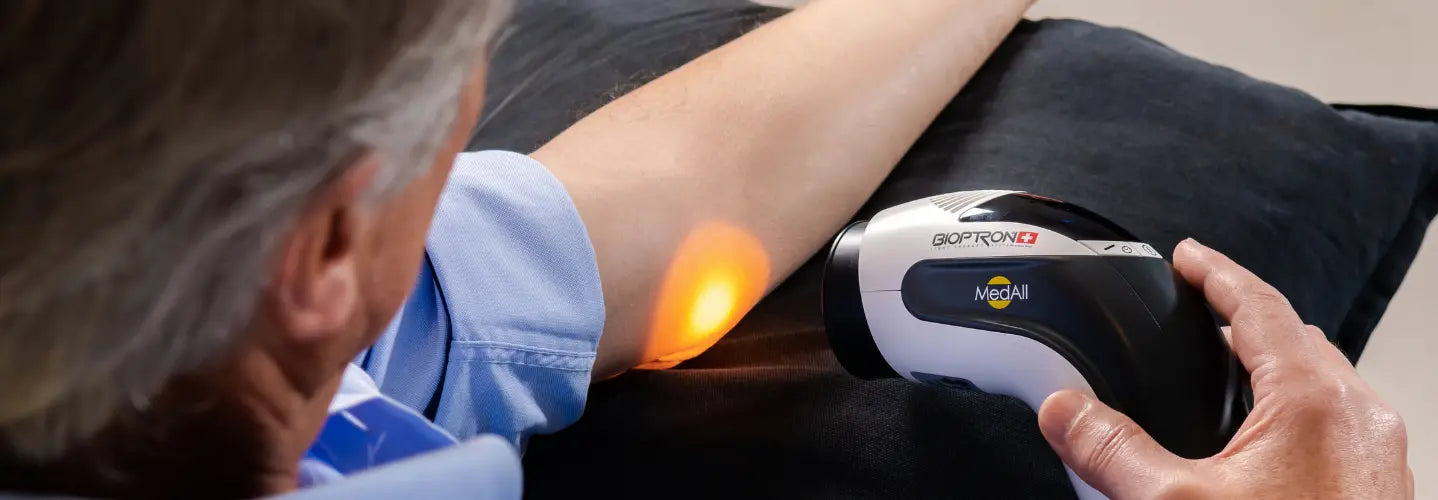
Someone who can sit comfortably, see the area clearly and hold a compact device steadily may prefer a simple targeted setup. For a small, accessible lower-leg area, a hand-held MedAll can make sense because it is compact and easy to bring to the chair or room where the person already spends time.
If hand steadiness or fatigue becomes an issue, the same MedAll can be paired with its floor stand so the person does not have to hold the device throughout the session.
A heel or hip that is awkward to reach
Now picture an older person lying on a bed while a family member helps with positioning. The challenge may be less about device weight and more about getting the light head into the right place, keeping it stable and avoiding repeated bending or reaching.
In that situation, a hands-free floor stand can make the session much easier to manage. The person can stay in the position their wound-care plan already requires while the carer adjusts the light around them.
Which BIOPTRON setup fits that real session?
Once you know where the person will be, how the wound can be accessed and who will position the light, choosing from the BIOPTRON Hyperlight range becomes much more straightforward.
BIOPTRON MedAll for compact, targeted positioning
BIOPTRON MedAll is our compact targeted option. It has an approximately 5 cm filter and a built-in digital timer, with guidance to position the light at about 10 cm and 90 degrees to the area. Its intended use includes wound care such as venous leg ulcers, pressure sores and burns.
For a small area that is easy to reach, MedAll can be a very practical home option. It is also the easiest model to move from room to room or bring to the person's usual chair or bedside position.
MedAll with a floor stand when holding becomes the problem
The MedAll floor stand is useful when the compact treatment format is right but hand-held use is not. It supports hands-free positioning and can be arranged around standing, seated or lying positions.
That can matter for a person with limited grip, reduced mobility or an awkward treatment angle. The stand does not make the light clinically stronger. It simply makes the physical job of keeping it steady easier.
BIOPTRON Pro1 when stand-supported reach and coverage matter
BIOPTRON Pro1 with floor stand is a Swiss-made Class IIa device with an 11 cm treatment filter. Its adjustable floor stand supports hands-free use, the head can rotate through up to 360 degrees, and the timer control and measuring tool are designed to help keep positioning consistent at the recommended 10 cm distance.
For wound-care setup, that can be valuable when you want a larger treatment field than MedAll and expect the stand to do more of the positioning work. Wound care is also included among Pro1's intended uses.
BIOPTRON 2 for a larger professional-style setup
BIOPTRON 2 with floor stand is the larger professional-style system in the range, with a 15 cm treatment filter and floor stand. We position it for professional environments including wound-care settings.
Its larger format can be useful where broader physical coverage and a dedicated stand-based setup suit the environment. It should not be read as proof that BIOPTRON 2 produces better wound-healing outcomes than MedAll or Pro1.
We would rather solve the positioning problem before you choose a model
When you speak with our BIOPTRON NZ team, we would rather understand the real session before recommending a wound-care setup. Where is the wound? How does the person normally sit or lie? Who will position the device? Is reach or mobility limited? Would hands-free use make things easier? How much repositioning is realistic?
One reason we believe BIOPTRON is worth considering is that the range gives New Zealand customers genuinely different physical setups instead of forcing every wound-care situation into one format.
That might mean compact MedAll use, MedAll with a floor stand, Pro1 with more stand-supported coverage, or BIOPTRON 2 where a larger professional-style setup is appropriate. The value is practical fit, consistent positioning and local guidance around the device you actually choose, not a promise that a more expensive model will heal a wound better.
What research can and cannot tell you about the device you are buying
Photobiomodulation research in wound care is not one single treatment recipe. Studies use different light sources, wavelengths, power densities, energy doses, treatment distances, session schedules, wound types and outcome measures. A recent systematic review of LED photobiomodulation for chronic lower-limb wounds also reported substantial variation between protocols and very low certainty in the evidence.
That is why results from an unrelated red LED or laser study should not be transferred directly to BIOPTRON. If you want to look at research collected specifically around BIOPTRON and its application areas, visit our BIOPTRON studies page.
For buying purposes, the most responsible conclusion is simple: use the evidence to inform the conversation, then choose a device that fits the assessed wound plan and can be used correctly in the real home setting.
What would make us tell you to speak to the wound team first?
If the wound is changing for the worse, device shopping can wait. Increasing redness, swelling, heat, discharge, odour, pain, fever, deeper tissue involvement or a wound that is clearly deteriorating needs clinical review rather than more experimentation with light exposure.
Diabetic foot wounds, significant pressure injuries, surgical complications and other complex wounds need appropriate professional management. If a wound is not improving as expected, do not simply increase BIOPTRON exposure. Go back to the wound-care team and have the plan reviewed.
Common questions
What should I look for in a light therapy device for wound healing?
Look for a device that is appropriate for the assessed wound, can be positioned without touching it, can stay at the instructed distance and angle, and is practical for the person or carer to use consistently. Treatment-field size, portability and hands-free support matter because they affect how easy the session is to set up, not because a larger device automatically means better healing.
Can I use a light therapy device on an open wound at home?
Potentially, but an open wound should already have appropriate assessment and a clear care plan. Wound care is included among BIOPTRON's intended uses, but home use should sit alongside the wound-care team's instructions and any prescribed dressing, pressure relief, compression, offloading, infection, vascular or diabetes management.
Should a dressing be removed before light therapy?
Do not remove or change a dressing just to fit light therapy into the day. If the wound can only be exposed during a dressing change, follow the wound-care team's instructions about when and how that happens. Prescribed wound-care timing should not be altered simply to accommodate BIOPTRON.
Is a handheld or stand-mounted light device easier for wound care?
It depends on the wound location and the person's reach, mobility and hand steadiness. A handheld MedAll can be convenient for a small area that is easy to reach. A floor stand can make repeated use easier when the area is awkward, the person tires easily, or a carer wants to keep the device steady without holding it throughout the session.
Does a larger treatment area mean better wound-healing results?
No. A larger treatment field may reduce how often the device needs to be repositioned over a larger area, but it does not prove better wound-healing outcomes. Choose the coverage that makes the physical session easier to perform correctly.
Can BIOPTRON be used at home for wound care?
Yes, BIOPTRON offers home-suitable options including MedAll and Pro1 setups. For wound care, we recommend choosing the model around the assessed wound, the person's body position, who will operate the device and whether hands-free positioning would help.
What is the difference between BIOPTRON MedAll, Pro1 and BIOPTRON 2 for wound-care setup?
MedAll is the compact targeted option with an approximately 5 cm filter and can be used by hand or with its dedicated floor stand. Pro1 has an 11 cm filter and an adjustable floor stand for hands-free positioning and broader coverage. BIOPTRON 2 has a 15 cm filter and a larger professional-style floor-stand setup. These differences are about physical fit and coverage, not proof that one model produces better clinical outcomes.
Do I need a clinician to approve light therapy for a wound before I buy a device?
For open, chronic, diabetic, pressure-related, infected, surgical, slow-healing or otherwise complex wounds, we recommend appropriate clinical assessment and an established care plan before adding a light therapy device. That keeps BIOPTRON in the right role as an adjunct rather than a substitute for wound management.
Tell us what one home session needs to look like
Before choosing a model, tell our NZ team four things: where the wound is, what the wound-care team has advised, where the person will sit or lie during use, and whether they will position the device themselves or have help.
From there, we can talk through whether a compact MedAll, a stand-supported MedAll, Pro1 or a larger BIOPTRON 2 setup makes the most practical sense for the way care already happens at home.
If you want personal help before you buy, use our free wound care consultation so we can focus on the setup, not just the specifications.
References
- Health New Zealand, Cuts, scrapes and wounds first aid.
- Health New Zealand, Surgical wound care.
- Miranda MB and colleagues, Clinical dosimetry and efficacy of LED photobiomodulation for chronic lower-limb wound healing: a systematic review of randomized trials, Lasers in Medical Science, 2026.
- BIOPTRON NZ, Studies, including wound-related references compiled for BIOPTRON Hyperlight.


